

There are seven Barker codes, and since October 2026 a machine-checked proof says there will never be another. Ask a room of radio operators how many exist, though, and you’ll hear seven, nine, or “nobody knows, they just stopped looking.” The Wikipedia and Wolfram MathWorld pages that search engines hold still give a version of that last answer. We drew all seven on one poster, with the autocorrelation of each Barker code and the two proofs that end the search. The poster is free.
Download the Poster
Both colourways of the poster are free to download as 18 x 24 inch PDFs.
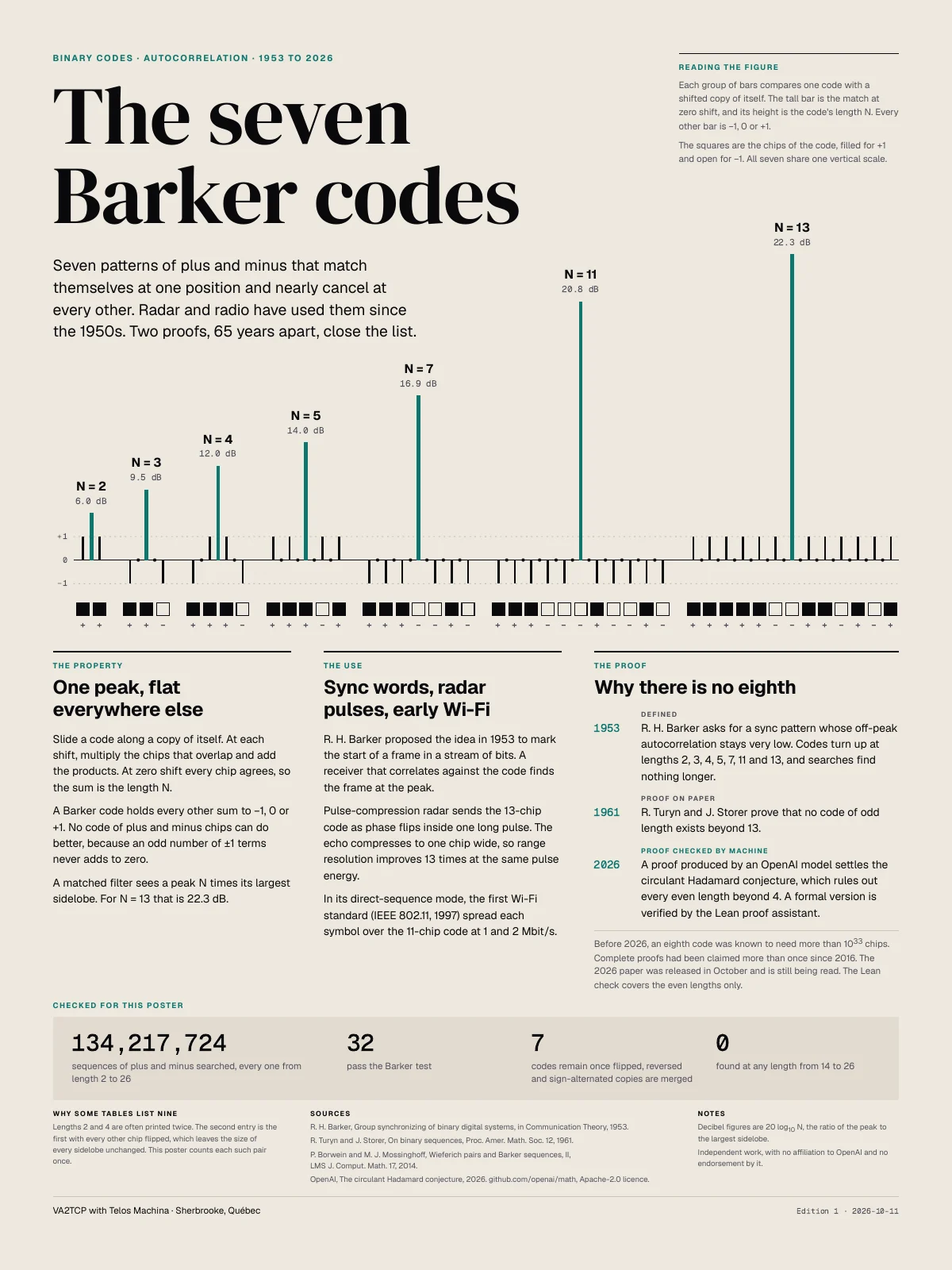
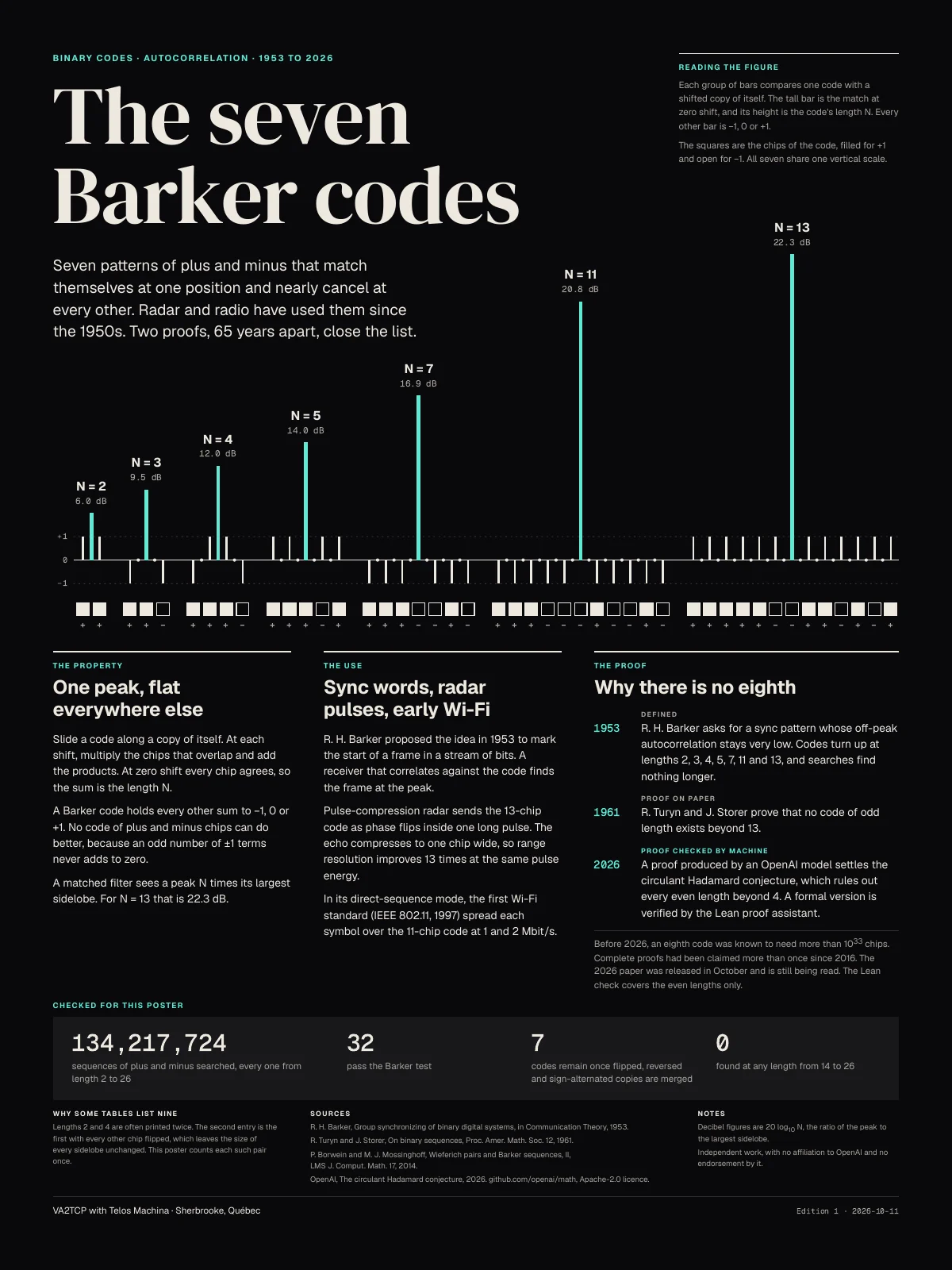
Print it for your station or your club. Each file is one vector page, so it scales down to letter size for a logbook and up to a wall print without going soft. The dark version looks like a scope trace. It also drinks ink.
The poster is released under the Creative Commons BY-NC-ND 4.0 licence. Share it freely with the credit line, keep it unchanged, and keep it out of commercial use.
What Is a Barker Code?
A Barker code is a short sequence of plus and minus chips whose autocorrelation has a single tall peak. Slide the code along a copy of itself. At each shift, multiply the chips that overlap and add the products.
At zero shift every chip agrees, so the sum equals the length N. A Barker code holds every other sum to −1, 0 or +1. No pattern of plus and minus chips can do better, because an odd number of ±1 terms never adds to zero.
That gives a receiver one unmistakable spike. A matched filter sees a peak N times its largest sidelobe. For the 13-chip Barker code that ratio is 22.3 dB.
| Length | Code | Peak over largest sidelobe |
|---|---|---|
| 2 | + + | 6.0 dB |
| 3 | + + − | 9.5 dB |
| 4 | + + + − | 12.0 dB |
| 5 | + + + − + | 14.0 dB |
| 7 | + + + − − + − | 16.9 dB |
| 11 | + + + − − − + − − + − | 20.8 dB |
| 13 | + + + + + − − + + − + − + | 22.3 dB |
Check It at Your Own Bench
Five lines of Python print every sidelobe of the 13-chip code. You don’t have to take a poster’s word for it.
def sidelobes(code):
    n = len(code)
    return [sum(code[i] * code[i + k] for i in range(n - k)) for k in range(1, n)]

b13 = [1, 1, 1, 1, 1, -1, -1, 1, 1, -1, 1, -1, 1]
print(sidelobes(b13))
The output alternates between 0 and 1, twelve values long. Flip the fourth chip and the sidelobes reach 4 in magnitude. That one experiment explains why these seven patterns earned a name.
The result fits on one sheet. Print the poster and pin it by the bench.
Sync Words, Radar Pulses, Early Wi-Fi
Barker codes do three jobs: frame synchronisation, radar pulse compression and the spreading code of early Wi-Fi. Ronald Hugh Barker (1915-2015), a British physicist and engineer, proposed the idea in 1953 to mark the start of a frame in a stream of bits. A receiver that correlates against the code finds the frame at the peak. MathWorks’ documentation still says their short length and low correlation sidelobes make them useful for that job.
Pulse-compression radar sends the 13-chip code as phase flips inside one long pulse. The echo compresses to one chip wide, so range resolution improves 13 times at the same pulse energy.
The first Wi-Fi standard, IEEE 802.11 in 1997, spread each symbol over the 11-chip code in its direct-sequence mode, at 1 and 2 Mbit/s. A code proposed in 1953 for frame sync ended up in the first direct-sequence Wi-Fi cards.
Where the 13-Chip Code Runs Out
Thirteen chips is the ceiling, and radar wanted more. Per Radartutorial, the 22.3 dB of the 13-chip code falls far below the 30 dB a radar requires. Compression also tops out at 13 to 1.
Designers worked around the limit. They nest one code inside another: 5 chips inside each of the 13, for 65 chips in all. The price is known. According to the textbook extract carried by ScienceDirect, some spurious lobes then exceed the 1/N ratio. Other families of waveform took over for long pulses.
That limit kept one question alive for decades: whether a longer code exists.
The Eighth Code
No eighth Barker code exists, and it took two proofs 65 years apart to show it. Our own search to length 26 found nothing longer than 13, and a search that finds nothing proves nothing. Greg Coxson, at a Worcester Polytechnic Institute workshop in 2008, still called it one of the older unsolved problems in radar and communications.
| What it rules out | Who | When | Checked by machine |
|---|---|---|---|
| Every odd length beyond 13 | R. Turyn and J. Storer | 1961 | No |
| Every even length beyond 4 | An OpenAI model | 2026 | Yes, in Lean |
The 2026 result closes the even-length half of the question. Before it, a 2014 bound from Borwein and Mossinghoff said an eighth code would need more than 10^33 chips. A sync word that long would outlast the contact and the operator.
The references have yet to catch up. As search engines last indexed it in September 2026, Wikipedia still described the even-length case as open, and Wolfram MathWorld’s page calls it a conjecture. If your handbook says “nobody knows”, it predates the proof.
One caution belongs here. Complete proofs had been claimed more than once since 2016, and OpenAI’s own paper cites five of them. The machine check is what sets this one apart: a formal version of the proof is verified by the Lean proof assistant. The paper was released on 6 October 2026, and we have seen no independent review of it yet.
What We Checked and What We Didn’t
We tested all 134,217,724 candidate sequences, from length 2 to 26, before drawing a single bar. The script found 32 that pass the Barker test, which reduce to 7 codes once flipped, reversed and sign-alternated copies are merged. It found none from length 14 to 26. The poster’s generator refuses to draw any sequence that fails the test, and every bar is computed from the code beside it.
Two limits, stated plainly. We read the Lean theorem and have yet to compile it on our own machine. And our first draft said radio had used these codes “since 1953”, which is the year of the proposal. The printed edition says “since the 1950s”.
Why Your Handbook Lists Nine
Tables that list nine Barker codes count lengths 2 and 4 twice. The second entry is the first with every other chip flipped, which leaves the size of every sidelobe unchanged. Count each such pair once and you get seven.
Free Reading
Four free sources cover the two proofs and the bound.
- OpenAI’s math release, with the paper and the Lean proof, under the Apache-2.0 licence
- Turyn and Storer, “On binary sequences” (1961), the odd-length proof
- Borwein and Mossinghoff, “Wieferich pairs and Barker sequences, II”, the 10^33 bound
- Schmidt and Willms, “Barker sequences of odd length”, a modern proof of the 1961 result
The poster is independent work, with no affiliation to OpenAI and no endorsement by it.
Questions Operators Ask
These four questions cover sharing, size and what comes next.
Can the poster go on a club website or in a newsletter?
Yes, a club website or newsletter can carry the poster. Link to this page or share the PDF as it is, with the credit line left in place. The licence allows any non-commercial sharing of the unchanged file.
Why 18 x 24 inches?
18 x 24 inches is a standard frame size, and it gives the 13-chip plot room to breathe.
What is the longest Barker code?
The longest Barker code is the 13-chip code. Its peak stands 22.3 dB above its largest sidelobe, and the two proofs described above rule out anything longer.
Will there be more prints?
More prints will follow if you tell us which one you’d hang. Write to us with the result or the diagram you want on your wall.
The poster was drawn in Sherbrooke by a certified amateur operator, under a Quebec call sign. Telos Machina builds AI workflow systems for Quebec businesses, and our process automation work runs on the same habit of checking by script before anything ships. Does your business run a process that deserves the same checking? Start with a workflow audit.
73 de VA2TCP